

PARIS, BASEL, BERLIN—AND THEN? Shirley Jaffe's Acts of Liberty
I pull a small, slightly blurry photograph of Shirley Jaffe from one of the gray boxes containing her archive in the Centre Pompidou. Somebody must have moved, either the photographer or the subject. The intimacy of the interior suggests it was taken by her husband, Irving. A brush in each hand, she seems to have just stepped back from her painting to examine the work. The space seems cramped. Another canvas stands on the floor close to the artist’s left leg; objects lean or hang against the wall.

Shirley Jaffe: The Woman in the Mirror
The artist Shirley Sternstein and the journalist Irving Jaffe married in 1949. That same year, after a short stay in Washington, D. C., they set sail for Europe on the SS De Grasse, more out of curiosity and a certain lack of purpose than with a particular goal in mind. Years later Shirley Jaffe told interviewer and art historian Avis Berman that they wanted to take advantage of Irving’s opportunity to study on the GI Bill.1
In 1981 she had described the experience to curator and art historian Merle Schipper in starker terms:
“It was an act of liberty, of taking on liberty. That’s something I didn’t know. And the minute I was there I knew it. And it was a terrible, terrible experience for me.”2
Once in Paris, the pair lived for a time in the town of Chaville just outside Paris, close to the painter Jules Olitski and his family. They later moved into the city (probably after a temporary return to the United States in 1952–53 after the death of Irving’s father), living in a series of hotels including one on the rue Fondary in the fifteenth arrondissement.
What did Jaffe paint during her first years in Paris? We can glimpse a fragment of it in the large mirror. No other trace of it exists today, and the portion visible here is admittedly quite small. But it seems to bear the traits of a lively post-Cubist style, the sort of work that was for a time being encouraged at Jaffe’s alma mater, Cooper Union in New York City. Her estate contains other traces of her earliest work in the broadest sense. A 1949 photograph from Washington shows this kind of “semi-abstract landscape” more clearly. 3
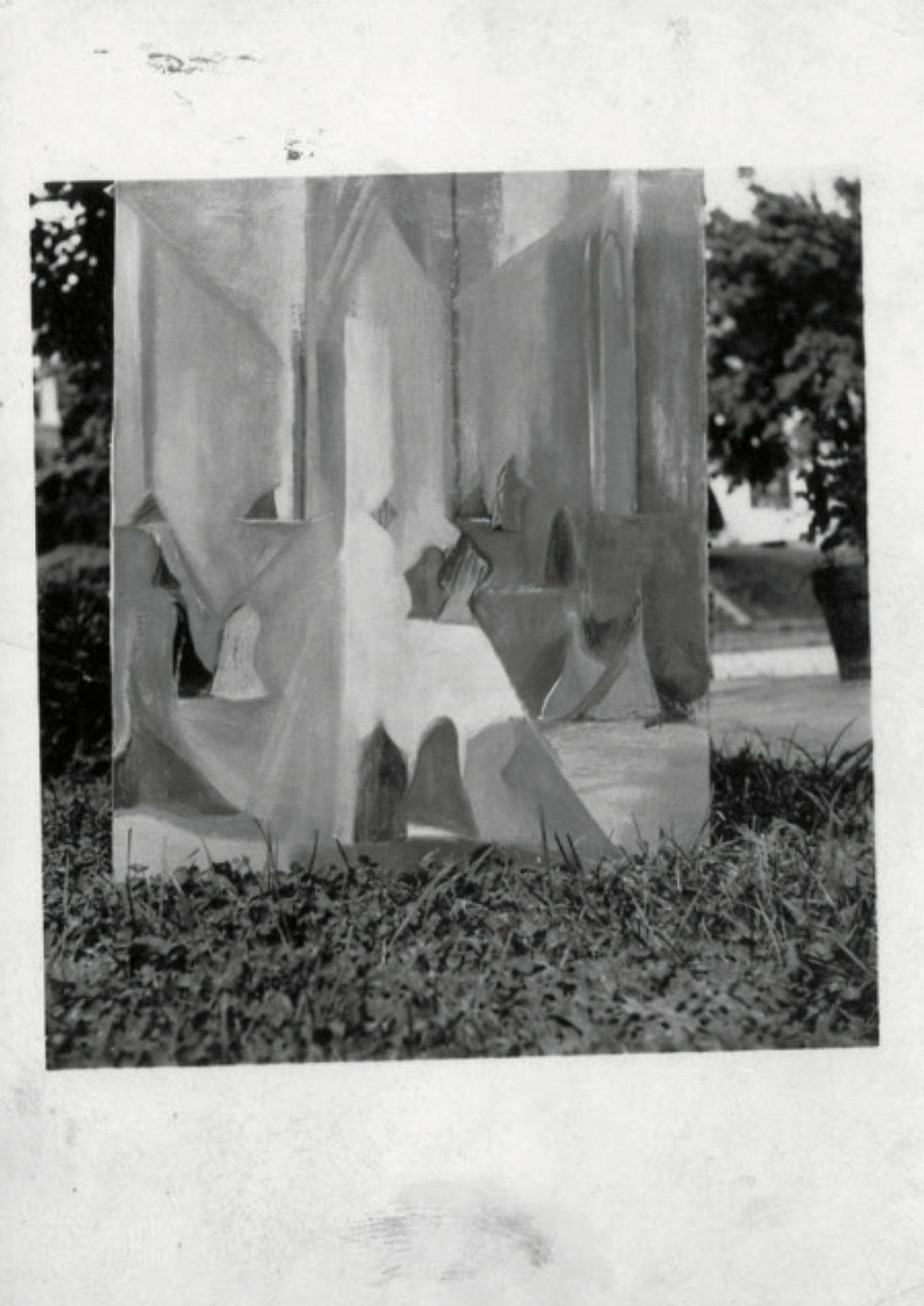
Based on her note on the verso, it appears to have been inspired by a small work in the
National Gallery of Art in Washington: A Temporary Tribune in the Campo San Zanipolo by Francesco Guardi. During her brief time with Irving in the U.S. capital, she had painted at the Phillipps Art School with the post-Cubist artist Karl Knaths.4
The work contained in this stack of photos is surprisingly figurative. There are fourteen in all, and at first I have a hard time believing Jaffe painted them. But her handwriting, added later, makes this clear enough, as do her comments on the sources of inspiration (Italy again!), the work process (the archival listing of color choices) and judgments about quality:
“1954 or early 1955 can’t remember 51 inches long Inferno from the Orvieto Frieze – Best color I’ve done: darks are red to orange lights are whites with the needed slants to pink, blue, green, yellow.”
The work she cites here is Luca Signorelli’s Dannati all’Inferno (The Damned in Hell), part of the fresco cycle that the Tuscan master painted in the Orvieto Duomo around
1500. Both of the references to art history in her early work point to Italy. And Italian painting would remain important for Jaffe, even her later works contain no such direct borrowings.
The Americans in Paris
The hotel on rue Fondary must have seemed a bit like a home away from home.
“And all of the hotels we lived in were filled with other Americans, because Americans could get these cheap hotel rooms by the month, but couldn’t find a real apartment.”5
An easy familiarity prevailed, one based on shared socioeconomic conditions and a spirit of optimism that multiplied among American artists—many of them studying on G. I. Bill grants6—who worked and exhibited together in Paris. Yet, with a few exceptions, French art critics and gallery owners treated the newcomers to a hostile, or at best in different, reception. The painter Jack Youngerman, one of the first “G. I. Students” to arrive in France, described the contradictory situation:
“We were obviously the philistines with our pockets loaded with dollars. [...] There was in general a kind of nationalist feeling and scorn for us.”
But Youngerman was surely offering an apt summary of what many American expats felt when he wrote that “being an American in Paris, seemed to me, [was] the thing to be.”7
The impression was fueled by the Americans’ sense that they were introducing a new
dynamic into art, one that extended far beyond the purview of the traditionalist courses on offer at such art schools as the Académie de la Grande Chaumière (which many found disappointing), or in the studios of artists like Ossip Zadkine and Fernand Léger. If New York in the 1950s was establishing itself internationally as the bastion of Abstract Expressionism, it was from the distance of Paris that members of a loose group of some three hundred American artists were able to form their own, more or less successful positions—before the majority of them returned to the U.S. a few years later. Jaffe, who was merely married to a former G. I., was at any rate excluded from such sources of financial support, and she worked alone without any institutional affiliations.8 Jaffe herself sought at first to keep an arm’s length from the French capital:
“At the very beginning, I found it very provincial. I wasn’t charmed by the things that most Americans love: the café, the browsing around together, the community, being recognized, et cetera. I liked that sense of anonymity that one had in New York. I didn’t want to become part of any intimate group, but of course, I did eventually.”9
Her “intimate group” included Sam Francis, who probably enjoyed the most success among all the American painters in Paris and who (Jaffe thought) tried rather to too hard to promote her. As she recalled to Avis Berman in 2010,
“At some point, I told him to stop, because I don’t like being overwhelmed with too much support. It’s as though you can’t handle yourself.”10
The circle also included the Canadian Jean-Paul Riopelle and the Americans Gaby and Kimber Smith, (occasionally) Joan Mitchell, Al Held, Janice Biala (Jack Tworkov’s sister) and Zuka (Zenaida Gourievna Booyakovitch Mitelberg). Together they represented a broad variety of styles and approaches to painting.
Basel And The New American Painting
It was Sam Francis who connected Jaffe to the man smiling impishly in this photograph as a kitten balances on his shoulder. Today Arnold Rüdlinger (1919–1967) is considered one of Switzerland’s most visionary exhibition makers.

The director of the Kunsthalle Basel from 1955 to 1967 had an eye for the most adventurous new currents in international art. In the spring of 1958 Rüdlinger brought "New American Painting / Die neue amerikanische Malerei" to his museum, a show organized by New York’s Museum of Modern Art (MoMA). He gave a special nod to Sam Francis, Shirley Jaffe and their circle in the speech that launched the historic traveling exhibition on its European tour:
“I owe a great debt of personal thanks to Sam Francis and the small colony he led in Paris. It was through their paintings and the conversations I had in their studios that I came to understand American painting, which was initially unfamiliar to me. They were largely responsible for strengthening my curiosity to the point that, via a trip to America that introduced me to many New York artists, [...] brought about the present outcome.”11
The show—curated by Dorothy Miller on an initiative of MoMA’s International Council—
assembled the work of seventeen American artists deemed important at the time.12 Francis was the youngest among them. Even in neutral Switzerland, the show’s semi-political dimen-
sion could not be ignored. In the same speech briefly switching into English to address the “American friends” directly—Rüdlinger clearly signaled that he was well aware of Switzerland’s unusual political position and that he intended to make use of it. Swiss neutrality indeed required a certain restraint in terms of foreign policy, he said, “but this neutrality gives us also the possibility to be open for all cultural problems and to act in a sense of freedom which is untouched by any nationalism.”13
Rüdlinger’s choice of the word “colony” to describe the Francis circle speaks to the uneven distribution of attention and success that the artists enjoyed at the time. That the tour began in Basel before continuing to its other European stations stemmed from his own
particular interest in postwar American abstract painting. In his foreword to the catalogue he
described the exhibition as an “instrument of information,” an opportunity to “thoroughly get to know and discuss the phenomenon of new American art.”14 If this served as a small jab at Miller’s rather broad selection of artists, two projects installed alongside the larger MoMA show made clear where his curatorial preferences lay: the solo exhibition of Jackson Pollock
(also taken from MoMA, and the first of its kind in Switzerland) and his own hanging in the Kunsthalle’s grand stairwell of work by members of “the colony”—the very artists who had ini-
tially kindled his enthusiasm for the new American art. Although these works were not included in the MoMA exhibition catalogue, their placement in the Kunsthalle stairwell served as a kind of outpost for the larger show.
Rüdlinger had already shown Jaffe’s work in three group exhibitions at the Kunsthalle Basel, among them "Japanische Kalligraphie – Westliche Zeichen" (1956), where the focus was not only on the influence of East Asian calligraphy but also on the more general “exemplariness of Asian pictorial space.”15
He also helped forge Jaffe’s first connections to the Swiss art scene. Others soon followed. The art dealer Eberhard Kornfeld gave her a solo show in 1959 at Klipstein & Kornfeld in Bern. The Basel-based gallery Handschin gave her another solo show in 1961 and represented her for a year. The extent of Rüdlinger’s curatorial influence on private collectors of contemporary art was clear in a 1966 show at the Kunstmuseum St. Gallen, Amerikanische Kunst aus Schweizer Besitz (American Art Owned in Switzerland), where the artists were lauded specifically as “his” discoveries. Works by Jaffe included in that show were The Plume (from Klipstein & Kornfeld) and The Red Line in Blue (from Handschin). Rüdlinger evidently appreciated Jaffe’s work. He purchased a few of her paintings on behalf of La Peau de L’Ours, an association of Swiss collectors that operated privately. Nonetheless, he did not choose to make her the focus of a larger project. As Camilla McHugh put it, Rüdlinger remained “anchored in prevailing old-boys’-club attitudes that saw institutions and exhibitions as realms re served for men.”16
Jaffe herself recalled the museum director’s incomparable intensity, not only in the way he looked at art but also in his “capacity for pleasure.”17 The photograph showing him with the kitten is not dated, but it may have been taken at the same time as the one that shows Jaffe, Joan Mitchell, Rüdlinger and another man (Werner Alder) standing together in Jaffe’s Paris studio and discussing a set of gouaches spread across the floor.

A selection may well have been underway here for inclusion in the 1958 installation of “the colony” in the Kunsthalle stairwell. Like many Europeans, Rüdlinger was taken with the idea that the origins of the new American painting lay in “the expanses” of America’s “prairies and woods,” even though most of “his” artists tended to come from the more cramped confines of the big city.18 If he enthusiastically embraced that formal language (“that outrageously large and free gesture that at first astonishes the European”), others found it decidedly more discomfiting. A critic writing in La Libre Belgique, for example, left the exhibition in a “state of real anxiety.” The strength that lay in the “frenzy of a total freedom” reflected poorly on Europe’s own abstract painters and practitioners of art informel; they looked like “pygmies” compared to the “disturbing power of these unchained giants.”19
If the “frenzy of total freedom” and the oversized formats are Abstract Expressionism’s most important features, then Jaffe never really belonged here anyway. The color choices and facture of her paintings are deliberate, not impulsive, even in a larger format work like Arcueil Yellow from 1956––an allusion to Francis’s studio in Arcueil, where they worked together for a while. She felt at the time that she was in an intellectual quandary.
“I knew that if I wanted to control my paintings, I’d have to control the gesture, but that would be intellectual dishonesty. If you are using gesture it has to be free. [...] I realized then that I had to find another manner, one that would have its own validity, that would be more honest.”20
The opportunity for Jaffe to put herself through precisely such a test would soon present itself, bringing about a radical break in her artistic practice.
Berlin: The Beginning of Something Else
Jaffe repeatedly mentioned that it took a long time before she considered pursuing
art as a career. It was only with the break from her husband in the early 1960s that she evaluated the situation in a new way.
“I never thought of a career. I think I began to realize that I was making a career only when I separated and divorced my husband. I realized I was still here. I did paint. I had to assume the fact that it had become a career.”21
A fellowship from the Ford Foundation made it possible for her to leave Paris for a year and spend time in Berlin. It was a welcome move, one that afforded her a greater measure of personal and artistic independence—independence from her husband’s financial support and freedom from the those early “abstract landscapes” from her first years in Paris. She was unhappy with these and thought they made her into something of a secondary figure (viewed, as she put it, as a “sous-Mitchell,” a “sous-Riopelle
or Francis”). 22
It would be hard to overestimate the importance of Jaffe’s time in Berlin for her work, even though she was quite critical of her paintings from that period and destroyed a great many of them.
“Critics have asked me so often—where can we see how B[erlin] has affected you—Not us; you—and they want to see a reflection of themselves—the look on canvas of the trees and the people and the houses and the dogs and the garden[s] and the lakes,”
Jaffe wrote at the be ginning of an enigmatic document found in her papers. Though the exact purpose and date of the text are unknown these two pages form a working draft of some sort. (Perhaps it was some kind of post-fellowship report or letter thanking the foundation.) Some of the writing is crossed out. In it, she fantasizes about what
it would be like to stay on.
“[W]hat kind of fun would one make in this city that dreams of its lost spirit and hesitates to pour out its new one.”23
And she concludes by saying that the city “has fed my spirit with the idea of possibility,
with the idea of audaciousness, with the idea of
all the possible variety one could suggest.”24
Her time in Berlin allowed her to hit on a kind of painting in which gesture is less evident and individual forms began to manifest themselves. The paintings, she writes, do not go far enough for her yet, “but there are forms that are emerging. The reliance on gesture is less evident. [...] they’re pushed, but not, to my mind today, enough. But they’re the beginning of something else.”25
In 1963, the year Jaffe took up her grant, West Berlin was hardly postwar Germany’s
most scintillating hotspot for art and culture. Far more, it served as a kind of collecting tank, a place artists came through on their way west or southwest (for example to the art schools in Dusseldorf, Karlsruhe and Stuttgart—where Willi Baumeister was a leading spirit, even posthumously—or to Ulm, where Max Bill had recently established a school of design).
The Berlin Wall and the strained political situation in Westberlin made for less than
optimal working conditions. In addition to some galleries, the city’s central art institution
was the Staatliche Hochschule für Bildende Künste, whose acting director from 1955 on was architect Karl Otto, a figure also strongly influenced by the Bauhaus. Certainly a few adventurous new galleries had opened in the early 1960s, with Werner & Katz drawing the most attention. It was here in October 1963 that an exhibition of work by a young East German artist who had resettled in West Berlin—Georg Baselitz—drew charges of “encouraging sexual lust and offending the sense of decency and morality.”26
Nonetheless Jaffe must have found Berlin virtually empty compared to Paris. Specu-
lating on the goals of the program that brought her there, she noted wryly, “it was specific to try to populate Berlin again with a semblance of culture.”27 Social activity was fairly subdued.28
Apart from that, she looked around the galleries and attended the Philharmonic, but otherwise she concentrated on her work. The Ford Foundation program also hosted Europeans, among them the composer and architect Iannis Xenakis, who introduced Jaffe to contemporary developments in music. The deeply political nature of the struggle surrounding art and culture in Germany during these years is already well known. Art, too, was supposed to serve that postwar imperative, Western integration. The Ford Foundation’s efforts are thus to be taken less as an attempt to enliven Berlin’s art scene than as an arm of cul tural diplomacy operating entirely to assert the autonomy of abstract art and its character as a supposedly beneficial and liberal international language. What scholars like Susanne Leeb have recognized as the “assertion of abstraction as a cultural political mission”—an ideological counterprogram to both Nazism and the doctrinaire approach to art in East Germany—was promoted by cultural oficers and Allied occupying powers. It was also embraced by art critics, patrons, and the artists themselves.29 Artists’ groups such as the ZEN49 (in Munich) and ZERO (in Dusseldorf) are also worth mentioning here, especially since Jaffe would have had the opportunity to see some of their exhibitions during her time in Berlin.
Her Berlin stay led to participation in two shows. One was the thirteenth edition of the exhibition organized by the Deutscher Künstlerbund (March 21–May 3, 1964), which integrated “foreign guests from the Ford Foundation” into its sprawling three-venue show. Jaffe was present with Grunewald (1964), a painting that incorporated the name of the Berlin forest into its name. The other was a more intimate show of Ford Foundation fellows, "Stadien und Impulse", at the Haus am Waldsee in Berlin’s Zehlendorf district (September 11–October 25, 1964). Will Grohmann— a champion of abstract art and one of Germany’s leading art critics at the time—greeted in the catalogue’s introduction the “painters and sculp tors contributing to the arts on the island of Berlin, who for their part should be inspired by this city’s much praised down-to-earth working climate.”30
His text mentioned the show’s two women, Jaffe and Ruth Francken, with the remark that was difficult to discern what was specifically “womanly” about their work. He also implied that Jaffe—after gaining “powerful momentum” from “the renewers of painting in the USA”— had sought “to acquire some painterly culture” in Paris, because her subjects were “more earthly, more inclined toward expressivity.”31
Both statements are false and show that Grohmann had no exchange with the artist prior
to writing those lines; Jaffe had had nothing whatsoever to do with the Abstract Expressionists during her time in New York. In Berlin, Jaffe was not only a foreign
guest from the U.S. but also had another, not entirely surprising experience: that of her alterity. When she started taking a German class, the teacher remarked that she pronounced certain words in a “Jewish” way, whereupon she promptly left the course. Years later she vividly recalled the experience as a sign that she was one of the few Jewish women living in Berlin at the time.
“I never felt particularly Jewish, but I assumed being Jewish.”32
Jaffe left Paris for Berlin just as Abstract Expressionism was in the process of being institutionalized as a “midcentury movement.”33
Many former Abstract Expressionists were seeking a new language, although Francis and Mitchell remained associated with the movement. Choosing to stay on alone in Paris after her Berlin fellowship, Jaffe launched a period of radical self-questioning. She deliberately ‘unlearned’ painting and started afresh.
“It was as though I was beginning with an ABC. Just one day I was able to have the courage to do that, trying to get, in the simplest form possible, what really interested me.”34
It would take stops in three cities for Jaffe to find the way to herself: first among the expats of a postwar Paris that was losing its international cultural significance; then to neutral but culturally and artistically open-minded Switzerland; and finally to the deeply war-scarred “island” of Berlin. It was only once she was ready to forget consciously everything she had picked up along the way that she could begin work on the paintings with which she would identify as an artist for the rest of her life.
This Essay was first published in Kunstmuseum Basel, Olga Osadtschy, Frédéric Paul (Ed.), Form als Experiment / Form as Experiment, Christoph Merian Verlag, Basel 2023. It was shortened for this publication. Copyright remains with the author.
Footnotes
1 Oral history interview with Shirley Jaffe, 2010 Sept. 27–28. Archives of American Art, Smithsonian Institution. Interview with Shirley Jaffe conducted by Avis Berman in Paris, audio recording (4 hours and 28 min.) with accompanying 94-page transcript, Transcript hereafter cited as “Jaffe Oral History.”
2 Merle Schipper, “Shirley Jaffe,” Woman’s Art Journal, vol. 2, no. 2, Fall 1981–Winter 1982, p. 46.
3 Jaffe Oral History, op. cit., p. 14.
4 The next year Knaths won first prize in a major competition organized by New York’s Metropolitan Museum of Art, which included the work of some three hundred American artists in its resulting exhibition American Painting Today—1950. Boycotting the project from the outset were eighteen representatives of Abstract Expressionism, who quickly became known as “the irascible 18.” (Spearheaded by Adolph Gottlieb, these included Ad Reinhard, Barnett Newman, Clyfford Still, Jackson Pollock, Mark Rothko, Hedda Sterne and Willem de Kooning, among others.) News of their open letter protesting that the juries involved were “notoriously hostile to advanced art.” made the front page of the New York Times (May 22, 1950) although the Times also celebrated the show when it opened as an “important affirmation of democratic principles” and a counterweight to art produced in “the Soviet bloc” (December 8, 1950). The episode underscores the self-confidence and contentiousness of the Abstract Expressionists on the New York art scene at the midpoint of the century. See Robert Beverly Hale, “A Report on American Painting Today—1950,” Metropolitan Museum of Art Bulletin New Series, vol. 9, no. 6, February 1951, p. 164.
5 Jaffe Oral History, op. cit., p. 18.
6 The U.S. government’s Servicemen’s Readjustment Act of 1944 (nicknamed the G. I. Bill) provided a range of benefits to veterans returning from World War II, including educational opportunities like tuition to institutions of higher learning and grants for study abroad. On the connection to art activities in Paris, see Arnold Herstand, “G. I. Students Show the Left Bank,” ARTnews, Summer 1949, p. 20.
7 Quoted in Debra Bricker Balken, “Americans in Paris: Artists Working in Postwar France, 1946–1962,” in Americans in Paris, Lynn Gumpert und Debra Bricker Balken (eds.), Munich, Hirmer, 2022, p. 49.
8 Ibid., pp. 53–54.
9 Jaffe Oral History, op. cit., p. 21.
10 Ibid., p. 31.
11 Quoted in Bettina von Meyenburg-Campell, Arnold Rüdlinger: Vision und Leidenschaft eines Kunstvermittlers, Zurich, Scheidegger & Spiess, 1999, p. 185. The first American artist Rüdlinger showed was in fact Alexander Calder. In 1947 he put on a show in Bern of works by Calder and Fernand Léger, who had met Calder after the war when he returned to Paris. Ten years later, in 1957, he reprised this exhibition at the Kunsthalle Basel.
12 The show’s first station was Kunsthalle Basel (April 19 to May 26, 1958) and moved to seven other European cities before ending a year later at MoMA (May 28–September 8, 1959). Dorothy Miller included works by William Baziotes, James Brooks, Sam Francis, Arshile Gorky, Adolph Gottlieb, Philip Guston, Grace Hartigan, Franz Kline, Willem de Kooning, Robert Motherwell, Barnett Newman, Jackson Pollock,
Mark Rothko, Theodoros Stamos, Clyfford Still, Bradley Walker Tomlin and Jack Tworkov. The US edition of the catalogue, published at the end of the tour, included excerpts from coverage of the exhibition in the European press. The New American Painting: As Shown in Eight European Countries, 1958–1959,
MoMA (ed.), New York, 1959.
13 Meyenburg-Campell, op. cit., p. 187. Of course Rüdlinger’s speech was not without its pathos; we should take his assertion that cultural policy can be free of nationalism with a grain of salt, especially since it was directed at an audience that in its own discourse claimed the concept of freedom for itself.
14 Arnold Rüdlinger, “Aus europäischer Sicht,” in Die neue amerikanische Malerei, Basel, 1958, n. p.
15 Ibid.
16 Camila McHugh, “Kühne Gesten,” Arnold Rüdlinger,
Neue Amerikanische Malerei (September 5–October 31, 2020), Basel, Galerie Mueller, 2020, p. 26.
17 Meyenburg-Campbell, op. cit., p. 94.
18 Rüdlinger, “Aus europäischer Sicht,” op. cit., n. p.
19 L. D. H., La Libre Belgique, Brussels, December 12, 1958, translated and anthologized in “International Reaction to Alfred H. Barr Jr., ‘The New American Painting,’” in Reading Abstract Expressionism: Context and Critique, Ellen G. Landau (ed.), New Haven, Yale University Press, 2005, p. 221.
20 Schipper, “Shirley Jaffe,” op. cit., p. 48.
21 Jaffe Oral History, op. cit., p. 29.
22 Ibid., p. 40.
23 Shirley Jaffe Papers, c. 1950–2011, Archives of American Art, Smithsonian Institution, Washington, D. C., Box 5, Folder 3.
24 Ibid.
25 Jaffe Oral History, op. cit., p. 42.
26 Baselitz’s painting Die große Nacht im Eimer, 1963, was deemed a sensational provocation at the time, something that the artist and the gallery had encouraged.
27 Jaffe Oral History, op. cit., p. 39.
28 Ibid., p. 42.
29 Susanne Leeb, “Abstraktion als internationale Sprache,” in Kunst und Kalter Krieg: Deutsche Positionen 1945–1989, Deutsches Historisches Museum Berlin, Cologne, Dumont Verlag, 2009, p. 121. Leeb’s essay notes the many contradictions that were glossed over in the general enthusiasm in the 1950s for abstraction as a purportedly universal language. She also elaborates on the extent to which imperialist arguments came into play and points to the rather fuzzy nature of the debate on artists who went into exile during the Nazi years.
30 Will Grohmann, “Artists in Residency: Begegnungen in Berlin,” in Stadien und Impulse, Berlin, Haus am Waldsee, 1965, n. p.
31 Ibid.
32 Jaffe Oral History, op. cit., pp. 40–41. Here Jaffe uses
the word “assumed” in the sense that she took on the identity.
33 Balken, op. cit., p. 100.
34 Jaffe Oral History, op. cit., p. 44.
Comments